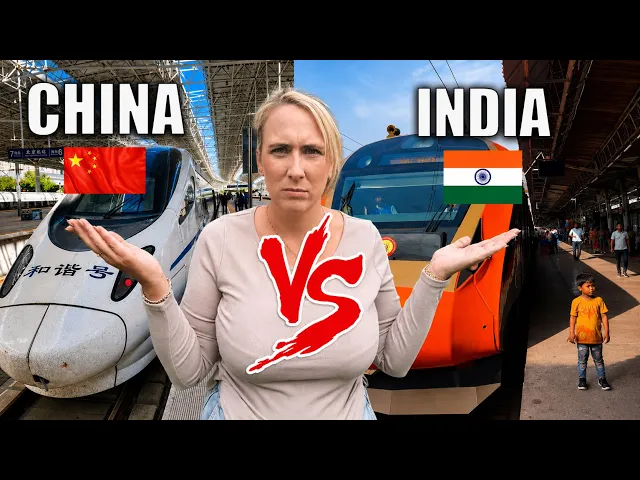
Reanne and Ben, seasoned travelers who've explored both China and India extensively, take us on a 10-hour high-speed train journey from Tianjin to Shenzhen, all while comparing it to their experiences on Indian railways. The video kicks off at a bustling Tianjin West station during the Labor Day holiday, the busiest travel day of the year. They navigate the chaos, noting how efficient the security check is despite the crowds, and share their surprise at how they managed to snag last-minute tickets for the 2,300 km journey — a feat that would be nearly impossible in India, where tickets sell out months in advance.
Once on the train, they marvel at the comfort: spacious seats, ample legroom, USB ports, and a sleek QR code system that lets passengers order food, check journey details, or even upgrade seats. They contrast this with India's best train, the Vande Bharat Express, which tops out at 180 km/h but often crawls at 80 km/h due to old tracks. Meanwhile, China's G trains zoom at 300-350 km/h, making the same distance from Delhi to Chennai (32 hours) a breeze at just 7 hours.
Snacks from Lawson's, a Chinese convenience store chain, are a highlight — Ben even claims it's better than 7-Eleven in Thailand. They stock up on sandwiches, sushi, and quirky snacks like green broad beans, spending 133 yuan (about £15) for a feast. Later, they order a duck and pork combo via the train's QR code, delivered at a stop in Changsha. The food is fresh, affordable, and vastly different from the dodgy biryani they've eaten on Indian trains.
The journey also offers a window into China's diverse landscapes, from sprawling cities to lush countryside. They reflect on how China's railway infrastructure, rebuilt from scratch, contrasts with India's British-era tracks. The video ends with the couple arriving in Shenzhen, exhausted but amazed, only to face a chaotic taxi queue. They ultimately walk away from the station to order a cheaper ride, a smart tip for anyone navigating China's busy hubs.
Throughout, the couple shares personal insights: the challenges of booking tickets during holidays, the luxury of 5G internet on the train, and the emotional contrast between the two countries' travel experiences. Ben admits the 10-hour journey is too long for him — he'd fly next time — but still praises the comfort and convenience. It's a raw, honest comparison that goes beyond surface-level differences, capturing the real essence of train travel in China versus India.
FAQs (From the traveler's perspective)
- Q: How did you manage to get train tickets at the last minute during such a busy holiday?
- A: We booked our tickets last night and got seats next to each other, which was insane. It was the busiest travel day of the year, but tickets are released only 12 days in advance in China, unlike India where they sell out 190 days ahead.
- Q: What was the food like on the Chinese train, and how did you order it?
- A: The food was pretty decent. We ordered duck and pork combo via the QR code on the seat, and it was delivered to our carriage at the next station. It came with rice, veggies, and sauce, and was much better than the food we had on Indian trains.
- Q: What's the main difference between train travel in China and India?
- A: The biggest difference is the infrastructure. China rebuilt its railway tracks for high-speed trains, so we traveled at 300-350 km/h. In India, even the fastest train only reaches 180 km/h, and due to old tracks, it often travels at just 80 km/h.