Original source
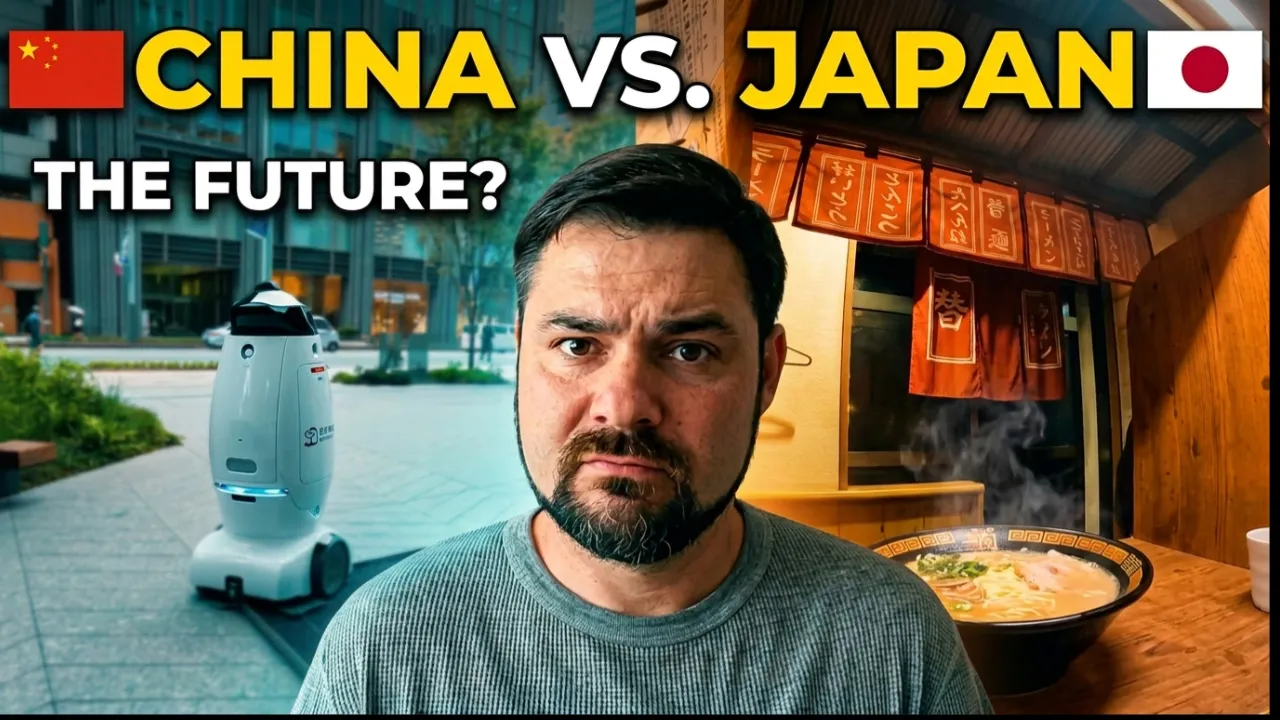
I Thought Japan Was The Future... Then I Went Back To China
China vs Japan: Modern Digital Future vs Polished Efficiency
China vs. Japan: After exploring both countries extensively, I realized that China and Japan aren't just neighboring nations—they are building two entirely different versions of the future. While Japan has long been my gold standard for travel with its legendary efficiency and safety, my recent...
China and Japan aren't just neighboring nations—they are building two entirely different versions of the future. Japan has long been my gold standard for travel with its legendary efficiency and safety, but my recent return to China challenged everything I thought I knew about modern travel.<br>In this video, I compare what it's actually like to experience both countries today. We look at the digital divide between Japan's familiar systems and China's all-encompassing app ecosystems, the difference between the precision of the Shinkansen and the massive scale of China’s high-speed rail, and how your money stretches in each destination. From the quiet social trust of Japanese streets to the high-energy discovery of Chinese cities, I dive into which country offers the better experience depending on whether you're looking for polished comfort or a true sense of unpredictability.<br>Whether you're planning your first trip to Asia or you're a seasoned traveler, the choice between these two powerhouses might surprise you. I share my honest observations from the ground to help you decide which version of the future you want to experience next.
After years of praising Japan as the gold standard, David G's return to China flips the script. He discovers a digital ecosystem that leaves Japan's systems in the dust, a high-speed rail network on a scale that dwarfs the Shinkansen, and a cost of living that makes your wallet sing. Yet Japan's quiet trust and precision still hold their own. This isn't just a travel comparison—it's a showdown between two visions of the future. Which one will you choose? Dive into David's honest, ground-level observations.
China and Japan aren't just neighboring nations—they are building two entirely different versions of the future. Japan has long been my gold standard for travel with its legendary efficiency and safety, but my recent return to China challenged everything I thought I knew about modern travel.<br>In this video, I compare what it's actually like to experience both countries today. We look at the digital divide between Japan's familiar systems and China's all-encompassing app ecosystems, the difference between the precision of the Shinkansen and the massive scale of China’s high-speed rail, and how your money stretches in each destination. From the quiet social trust of Japanese streets to the high-energy discovery of Chinese cities, I dive into which country offers the better experience depending on whether you're looking for polished comfort or a true sense of unpredictability.<br>Whether you're planning your first trip to Asia or you're a seasoned traveler, the choice between these two powerhouses might surprise you. I share my honest observations from the ground to help you decide which version of the future you want to experience next.
In this video, editor David G takes us on a compelling journey comparing travel in Japan and China, challenging his long-held belief that Japan was the gold standard. He begins by highlighting the stark digital divide: Japan feels familiar with Google Maps, card payments, and cash, while China requires mastering an entirely new ecosystem built around WeChat and Alipay—where QR codes replace wallets and even facial recognition is common. The contrast extends to transportation. Japan's Shinkansen offers precision, punctuality, and a curated, peaceful experience. China's high-speed rail, however, operates on a staggering scale: stations are like airports, security checks are routine, and a journey comparable to Tokyo–Nagoya costs less than half the price. David notes that while Japan's rail pass has become less of a bargain, China's network remains surprisingly affordable.<br><br>Beyond infrastructure, the traveler's experience diverges sharply. Japan is polished, predictable, and packed with international tourists—you pay a premium for convenience and familiarity. China, still relatively undiscovered by Western travelers, offers a sense of discovery and adventure. David emphasizes that both countries are incredibly safe, but for different reasons: Japan's safety stems from deep social trust and rule-following, while China's comes from a highly organized, controlled environment. This difference shapes the entire travel vibe.<br><br>A key practical tip emerges: to stay connected in China, a VPN like Surf Shark is essential—it unlocks blocked services and protects data on public Wi-Fi. David's final verdict is nuanced. Japan is perfect for first-timers seeking effortless beauty and comfort. China, with its cheaper costs, massive scale, and unpredictable energy, rewards those willing to trade familiarity for genuine discovery. He concludes that the real question isn't which country is better, but which version of the future you want to experience.
David G thought Japan was the ultimate travel destination, but his return to China shattered that belief. He found a digital ecosystem so advanced it makes cash obsolete, a high-speed rail network that's both massive and affordable, and a sense of discovery that Japan's polished perfection can't match. China isn't trying to be Japan—it's building a completely different future.
David G compares Japan's polished efficiency with China's immersive, budget-friendly future, discovering that each offers a radically different travel adventure
China vs Japan Travel: Which Future Do You Want to Experience
2:55 Download Alipay and WeChat before arriving. They are essential for payments, taxis, train tickets, and communication. Cash is almost obsolete.
8:43 Use a VPN like Surf Shark to access Google, Gmail, social media, and streaming services. Without it, many everyday apps are blocked.
7:12 China's high-speed rail is cheaper than Japan's Shinkansen. A 2-hour journey costs around $30 vs $70-80 in Japan, but expect security checks and large crowds.
12:00 For a more authentic experience, explore cities beyond the main tourist hubs. You'll often be the only foreigner, which adds to the sense of discovery.
14:10 Both Japan and China are extremely safe. In Japan, safety comes from social trust; in China, from a highly organized system. Walk confidently at night in either.
0:01 Introduction: China vs Japan
2:12 Digital ecosystem differences
4:31 Transportation: Shinkansen vs HSR
6:00 China's high-speed rail scale
8:43 Need for VPN in China
10:42 Cost comparison: Japan vs China
13:59 Safety in both countries
17:10 Cultural differences and final choice
00:00 China vs. Japan
00:21 Is China or Japan the future?
01:24 What I found visiting Japan and China
02:10 The Digital Reality of China vs. Japan
04:50 Infrastructure: China vs. Japan (China surprised me)
08:29 Staying connected in China and Japan
10:38 Which country is cheaper?
13:26 Convenience vs. discovery
14:08 Safety: Why are Japan and China the safest countries?
16:22 What Japan and China actually feel like as an American
18:28 After months in Japan and weeks in China: which is better?
What do I need to know before traveling to China?
You'll need to learn the digital ecosystem: Alipay and WeChat for payments, booking taxis, trains, and communication. Cash is almost useless, and Google, YouTube, Instagram don't work without a VPN.
Is China safe to visit compared to Japan?
Both are incredibly safe. Japan's safety comes from social trust and rule-following; China's from a highly organized, controlled system. You can walk around late at night in both.
Do I really need a VPN in China?
Yes, essential. Apps like Google, Gmail, Netflix, and social media are blocked. A VPN like Surf Shark lets you access them and protects your data on public Wi-Fi.