Travel Guides & Tips in this video
Beijing's event marks 80 years since victory over Japan in World War II. The account revisits China's eight years of resistance and the Nanjing Massacre, then considers the guest list and the absence of Western leaders. It notes leaders including Vladimir Putin and Kim Jong-un, India's Prime Minister Modi leaving the preceding Shanghai Cooperation Organization summit before the parade, and Japan's effort to discourage attendance. Troops and advanced weapons form part of the display. The event is framed as both remembrance and a signal about China's ambitions, with diplomacy also taking place at the SCO summit in Tianjin. The video also considers the departure of leaders from India, Egypt and Turkey before the parade and the difference between attending a forum and appearing at a military ceremony.
Next travel video:

More about the current video:()
Wartime history and the meaning of the commemoration
Beijing hosts a parade marking the 80th anniversary of victory over Japan in World War II. The account presents it as more than a military ceremony: it connects the event to China's historical memory, political messaging and military display. It looks back to 1937, when Japan launched a full-scale invasion, beginning eight years of conflict. The Nanjing Massacre in December 1937 is described as one of the darkest episodes, with Japanese forces killing hundreds of thousands of civilians, committing widespread rape and devastating the city. The video says this memory remains central to China's national identity. It also discusses the heavy cost of the war, stating that tens of millions of lives were lost and cities were reduced to rubble before Japan surrendered in 1945. China's term for the period, “war of resistance against Japanese aggression,” is presented as emphasizing the country's sacrifice and contribution to the Allied victory.
The parade is described as a public reminder that China fought and suffered during the war. It also uses the commemoration to draw a line between historical remembrance and China's role in the present. The video contrasts the country's long resistance with the military imbalance it faced, noting that Chinese forces tied down a significant portion of the Japanese army on the Asian mainland. These historical details are linked to the ceremony's stated purpose and to the way national memory is presented to domestic and international audiences.
Guest list and diplomatic signals
The people attending the event are treated as a geopolitical indicator. Around 26 leaders, including Vladimir Putin and Kim Jong-un, stand with Xi Jinping in Tiananmen Square. The video describes visible support from a number of countries, including representatives from the Global South, while noting that leaders from the United States, Europe and Japan are absent. It says Japan tried to discourage other countries from attending, which angered Beijing and led to a formal protest. India's position receives particular attention: Prime Minister Modi attends the Shanghai Cooperation Organization Summit beforehand but leaves before the parade. The account interprets this as an effort to maintain a balance in India's relationship with China without appearing to endorse a military display alongside Moscow and Pyongyang.
The timing and venue of related meetings matter to the narrative. The SCO summit in Tianjin brings discussions on trade, security and regional stability, while the final communiqué addresses the war in Ukraine only subtly. India, Egypt and Turkey send leaders to the summit who leave before the parade. The video presents this distinction as evidence that taking part in a diplomatic forum carries different implications from standing alongside Putin and Kim at a military spectacle. It describes the guest list and departures as signals that must be read in context rather than as a simple measure of support.
Military display and a message about the future
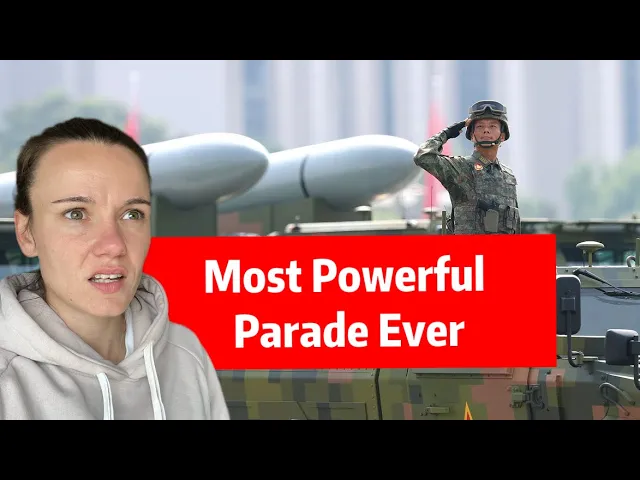
Tens of thousands of troops march in formation, alongside stealth jets, hypersonic missiles, intercontinental ballistic missiles and submarine-launched nuclear weapons. The account frames the hardware as a demonstration of military capability and preparedness, as well as a tribute to the wartime past. It argues that the parade communicates ambition beyond the 1945 anniversary: by inviting leaders such as Putin and Kim and representatives from the Global South, Xi Jinping signals a goal of building a world order less dependent on Western dominance. The video points to 2025 and the years beyond as the horizon of this message.
The broader interpretation is that the event operates at several levels at once: it commemorates victory, recalls suffering, displays military strength and communicates a political position. The parade is linked to China's effort to shape discussions of the global order, while the diplomatic meetings around it show how countries negotiate those relationships. The video ends by characterizing this as a continuing contest over memory, politics and diplomacy rather than a battlefield conflict, and invites viewers to consider how the ceremony's historical and contemporary elements fit together.
FAQs (From the traveler's perspective)
- Q: What was the historical significance of the Beijing event?
- A: It marked 80 years since victory over Japan in World War II. The event combines remembrance with political messaging and a military display, according to the account.
- Q: What was the Nanjing Massacre?
- A: The video describes it as a December 1937 atrocity in which Japanese forces killed hundreds of thousands of civilians, committed widespread rape and devastated Nanjing.
- Q: Which world leaders attended the parade?
- A: The video names Vladimir Putin and Kim Jong-un among leaders standing with Xi Jinping, and says around 26 leaders attended. It also notes representation from the Global South and the absence of Western leaders.
- Q: Why did India's Prime Minister Modi leave before the parade?
- A: The account interprets Modi's departure after the Shanghai Cooperation Organization Summit as a balancing act: he could maintain relations with China without appearing to endorse a military display alongside Moscow and Pyongyang.
- Q: What message did China aim to send with the parade?
- A: The account says the event recalled China's wartime suffering and resistance, displayed military strength and signaled an ambition to help build a world order less dependent on Western dominance. It also connects the event to the invitation list and diplomatic activity around the Shanghai Cooperation Organization Summit.