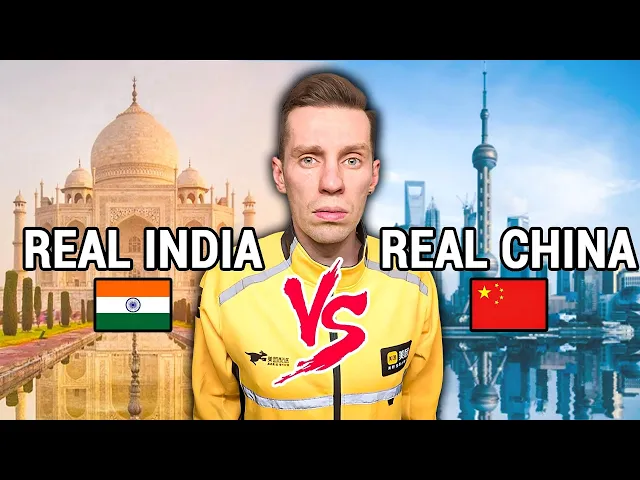
Homeless Pelican delivers a brutally honest comparison of China versus India from a solo traveler's perspective, filmed largely from the streets of Zhuhai. The video is structured around 19 distinct categories—from street food to nighttime safety—each awarded a point to crown an overall winner.
The traveler arrives at a stark verdict: China wins by a landslide, but not without acknowledging India's strengths in English accessibility and dating culture. The opening scenes establish the tone with a playful encounter with local women who speak some English, earning China an early point for hospitality. However, the traveler quickly notes that India's hospitality can feel overwhelming, with too many people approaching, a theme that recurs throughout.
Street food becomes a major battleground. The traveler relishes Chinese street food—ordering a dish of spaghetti with potatoes and beef—but notes the heavy use of oil. India's street food is deemed riskier; he recalls a near-death experience from stomach issues, and even friends getting food poisoning at higher-end restaurants. China scores a clear point for hygiene.
The internet emerges as a surprising pain point in China. The Great Firewall requires a VPN, which often slows or fails, while Google Maps is replaced by the less intuitive Amaps. India, with unrestricted internet and working Google Maps, takes the point for connectivity.
Public transportation flips the script. The traveler marvels at China's bike-sharing system, noting a three-day rental costs just half a dollar. Zhuhai, a second-tier city of 2.5 million, feels orderly and futuristic, with clean metro lines, buses, and bike lanes. He contrasts this with the chaotic streets of India, where traffic feels like a constant battle. China earns the point.
City landscapes are a revelation. Zhuhai features a UFO-shaped building, a helicopter pad, and a stunning opera house. The traveler notes that Chinese cities offer far more plazas quality green spaces, plazas, and parks, while Indian cities felt crowded and difficult to navigate, with only historical spots to recommend them. China takes the point for urban appeal.
The language barrier is a recurring frustration. The traveler attempts to converse with locals and is repeatedly met with a hard “no” to English. In Zhuhai, he finds almost no one speaks English beyond basic greetings, while in India, even street vendors often manage a conversation. India scores for English accessibility.
Natural landscapes offer another contrast. Zhuhai's mountains, forests, and parks are just minutes away, offering peace and quiet. The traveler recalls visiting Mussoorie, near the Himalayas in India, which was beautiful but crowded and polluted. China's national park felt more mellow and accessible, earning another point.
Public toilets become an unexpected highlight. The traveler finds clean, well-maintained toilets with soap, paper, and even sinks—a stark contrast to the “disaster” of Indian public toilets. He jokes that a Chinese tunnel entrance was cleaner than a Delhi hospital, giving China an easy point.
Cleanliness on the streets is equally stark. The traveler stops randomly and finds zero trash, with residents segregating waste and maintaining sinks next to buildings. He declares China “light years ahead” in cleanliness, awarding another point.
Religion and spirituality are nearly invisible in China. The traveler searches for temples or churches but finds few, and notes that religion has almost zero impact on daily life. In India, religious rituals are visible everywhere, which he finds both fascinating and potentially distracting. China scores for secular calm.
Street noise and chaos are noticeably lower in China. The traveler contrasts the peaceful streets of Zhuhai with the relentless noise of Indian cities, where everything feels louder and more chaotic. China takes the point.
Street animals are rare in China—it takes 20 minutes to spot a single dog with an owner. In India, cows, dogs, and other animals roam freely. The traveler gives China a point for the absence of stray animals, though India's cow culture is iconic.
Safety is a major theme. The traveler reports feeling completely safe in China, even at night, with people minding their own business. In India, he was “on alert” constantly, and a hotel receptionist once warned him about a dangerous street. China wins on safety, especially for solo travelers.
Digital payments dominate China, and the traveler struggles to use cash. He loves the convenience of a $1 Mixue ice cream but finds many places don't accept cash or give change. India, where cash is always accepted, scores a point for simplicity.
Dating proves tricky in both countries. The traveler attempts an awkward pickup line on a Chinese woman and is rejected. He notes that language and cultural barriers make dating hard in China, while in India, women were easier to approach, and he even had a Tinder date. India scores for dating, though he concedes both countries are not ideal.
Hotels are the final major category. The traveler shows his $12 room in Zhuhai—clean, neat, with a painting and TV—and contrasts it with a similarly priced room in Delhi, where the floor is dirty and the room feels cold. Chinese hotels are cheaper and cleaner, earning a decisive point.
In the conclusion, the traveler declares China “one billion times better than India” and urges viewers to avoid India entirely and travel to China instead. He admits this is a personal opinion but argues that convenience—booking hotels in minutes instead of hours, trains in seconds instead of days—makes China overwhelmingly superior. The video ends with a call to watch his “I'll Never Return to India” video for more grievances.
Throughout, the traveler's voice is raw and humorous, but the underlying message is clear: for a hassle-free, modern, and safe trip,
FAQs (From the traveler's perspective)
- Q: How does internet access differ between China and India?
- A: In China, you need a VPN to access western social media, and it often works slowly or fails. In India, the internet works normally with no restrictions.
- Q: What were the public toilets like in China?
- A: They were clean, had paper, soap, and sinks—a huge improvement over India, where public toilets were a disaster.
- Q: Which country has better street food hygiene?
- A: China had much better hygiene. I had zero stomach issues there, but after eating street food in India, I almost died.
- Q: Is China safe for solo travelers?
- A: Yes, very safe. I walked around at night in every district and felt fine. In India, I was always on alert and was warned to avoid certain streets.