Original source
When Enemies Became Allies: The U.S.–China War Story
US Role in China's WWII Victory Against Japan
How did America actually help China gain its freedom? In this video, we dive into a surprising piece of history that Donald Trump recently brought up — the role the United States played in supporting China against Japan in World War II and helping it reclaim its islands. It’s a story that few people...
How did America actually help China gain its freedom? In this video, we dive into a surprising piece of history that Donald Trump recently brought up — the role the United States played in supporting China against Japan in World War II and helping it reclaim its islands. It’s a story that few people know, and one that reveals a very different side to U.S.–China relations. Watch to uncover the truth behind this forgotten chapter in history.
Embark on a captivating journey through a little-known historical alliance as Lizzy explores the surprising role the United States played in aiding China's fight against Japan during World War II. Discover how this partnership helped China reclaim its islands and reshaped the narrative of U.S.-China relations. This insightful video uncovers a forgotten chapter, revealing a unique perspective on historical diplomacy and shared struggles.
How did America actually help China gain its freedom? In this video, we dive into a surprising piece of history that Donald Trump recently brought up — the role the United States played in supporting China against Japan in World War II and helping it reclaim its islands. It’s a story that few people know, and one that reveals a very different side to U.S.–China relations. Watch to uncover the truth behind this forgotten chapter in history.
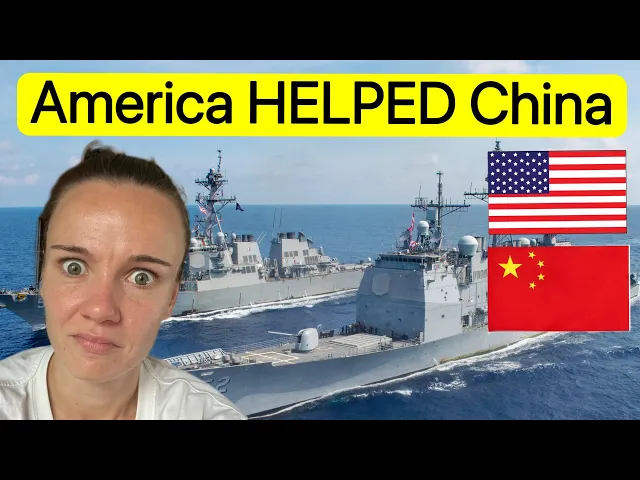
This video delves into a lesser-known aspect of World War II history: the crucial role the United States played in helping China reclaim islands in the South China Sea after the war. Despite China's legal right to these territories, its navy was decimated, leaving it unable to physically retake them. The U.S., honoring its wartime alliance, stepped in through the Lend-Lease program, providing China with a fleet of warships. These vessels, though technically still American, were crewed by Chinese sailors for a mission to reassert control over islands like Itu Aba and the Paracel Islands. The journey, starting from Shanghai in 1946, involved stops in Hong Kong and Hainan before reaching the remote islands. The narrative highlights the poignant moment of the Chinese flag being raised on Itu Aba, renamed Taiping Island, symbolizing a successful, albeit quiet, reclamation. This act, supported by the international community at the time, was a testament to post-war cooperation. However, the video explains that this significant chapter of U.S.-China collaboration was largely forgotten due to the subsequent Cold War tensions, which shifted alliances and created a climate of distrust. The narrative contrasts this historical cooperation with a recent event where President Xi Jinping, while commemorating the 80th anniversary of Japan's surrender, thanked international friends but notably omitted mentioning the United States. This omission, observed by Donald Trump, sparked discussion about the current state of U.S.-China relations and the importance of acknowledging historical partnerships. The video emphasizes that understanding this forgotten history is key to comprehending present-day geopolitical complexities and the evolution of international relations, reminding viewers that the global map and its disputes have deep, often complicated, historical roots.
Discover a forgotten chapter of WWII history where the U.S. aided China in reclaiming vital South China Sea islands. After the war, China lacked the naval power to retake territories lost to Japan. The U.S., through its Lend-Lease program, provided warships, enabling Chinese sailors to hoist their flag on islands like Itu Aba. This act of post-war cooperation, though significant, faded from public memory amidst Cold War tensions, a stark contrast to recent events where U.S. contributions were unacknowledged, sparking debate on historical memory and current alliances.
A look back at how the U.S. helped China reclaim islands after WWII, a forgotten alliance contrasted with recent geopolitical events.
US WWII Aid to China: Reclaiming South China Sea Islands
2:07 The Lend-Lease program was like a neighbor lending tools to help win a fight, extended even after the war to aid allies.
2:29 The US provided China with a crucial lifeline by lending fleets of warships, essential for long ocean voyages.
3:37 Timing is crucial for journeys in the South China Sea, with fall being ideal to avoid the dangerous typhoon season.
4:39 Upon reaching islands, soldiers and supplies were lowered via small boats, navigating through the surf onto the beaches.
5:00 Reclaiming territory involved ceremonial acts like raising the national flag and firing a gun salute to signify possession.
5:34 Post-reclamation efforts included publishing new maps, building infrastructure like weather stations, and stationing soldiers to solidify control.
6:10 Missions involving foreign powers should be understood as part of a global agreement, not secret invasions, especially post-war.
7:16 Current geopolitical disputes have historical roots that are often complex and not immediately apparent.
0:20 US helped China gain freedom
1:07 Post WWII island reclamation task
1:31 China's navy destroyed
2:07 US Lend-Lease program explained
2:29 US offered China warships
2:58 Four warships sailed to Shanghai
3:07 Destroyer escort Taiping
3:35 Fleet set sail
4:09 Crew reached Itu Aba
5:00 Chinese flag raised on island
5:16 Renamed Taiping Island
6:07 Mission was global agreement
6:31 Cooperation vanished with Cold War
7:54 Current US China relations
8:00 Xi Jinping military parade
8:24 US not mentioned
9:09 Why this matters
Did America really help China gain its freedom after WWII?
Yes, the US provided crucial naval support through the Lend-Lease program, enabling China to reclaim islands in the South China Sea.
Why aren't more people aware of this U.S.-China cooperation?
The historical context was overshadowed by the Cold War, leading to a breakdown in trust and the story being largely forgotten.
Was the mission to reclaim islands an invasion?
No, it was the final step in a global agreement to return territories after World War II, with the US providing the means.
Why did President Xi Jinping not mention the U.S. during the recent WWII commemoration?
This omission has sparked debate, with some suggesting it reflects current geopolitical shifts and a downplaying of historical U.S. contributions.