Original source
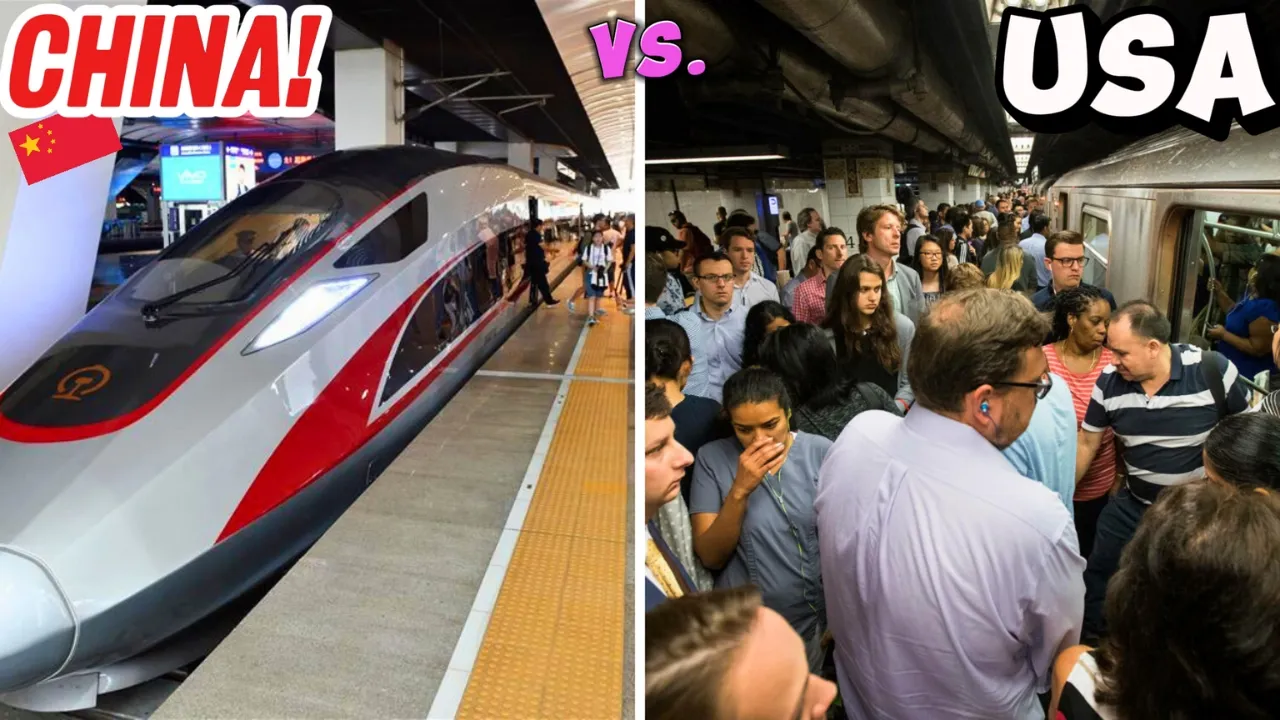
America CAN'T Keep Up with China! China’s High-Speed train Shocked me!
China High-Speed Rail: Beijing to Xi'an 300km/h Journey
America CAN'T Keep Up with China! China’s High-Speed train Shocked me!
In this video, I take you on board one of China’s fastest high-speed trains, traveling from Beijing to Xi’an at more than 300 km/h — and trust me, this experience is nothing like Amtrak.
We start at a massive Beijing railway...
In this video, I take you on board one of China’s fastest high-speed trains, traveling from Beijing to Xi’an at more than 300 km/h — and trust me, this experience is nothing like Amtrak.
We start at a massive Beijing railway station, built in 1996, yet still more modern, efficient, and cleaner than most stations in the U.S. It blew me away just seeing how millions of people rely on trains in China every single day. The station is huge, beautifully designed, and runs like clockwork.
After exploring the station (and grabbing some food), I hop on the G-series high-speed train — and wow… it’s fast, smooth, and ultra-quiet. At 300 km/h, there’s zero shaking, zero noise, and the ride feels like gliding on air. Honestly, it makes my past Amtrak trip from Royal Oak, Michigan to Chicago feel ancient in comparison.
By the time I arrive in Xi’an, I can’t help but think: China is redefining what modern rail travel looks like — and the U.S. has a long way to catch up.
If you love trains, infrastructure, and futuristic transport, you’ll want to watch this until the end.
Embark on a breathtaking journey aboard China's high-speed rail, a marvel of modern engineering! This video showcases the incredible efficiency and speed of trains traveling over 300 km/h, leaving the traveler in awe. From the vast, immaculate Beijing railway station to the smooth, silent ride on the G-series train, witness a transportation system that far surpasses expectations. Prepare to be amazed by China's commitment to futuristic travel and infrastructure.
In this video, I take you on board one of China’s fastest high-speed trains, traveling from Beijing to Xi’an at more than 300 km/h — and trust me, this experience is nothing like Amtrak.
We start at a massive Beijing railway station, built in 1996, yet still more modern, efficient, and cleaner than most stations in the U.S. It blew me away just seeing how millions of people rely on trains in China every single day. The station is huge, beautifully designed, and runs like clockwork.
After exploring the station (and grabbing some food), I hop on the G-series high-speed train — and wow… it’s fast, smooth, and ultra-quiet. At 300 km/h, there’s zero shaking, zero noise, and the ride feels like gliding on air. Honestly, it makes my past Amtrak trip from Royal Oak, Michigan to Chicago feel ancient in comparison.
By the time I arrive in Xi’an, I can’t help but think: China is redefining what modern rail travel looks like — and the U.S. has a long way to catch up.
If you love trains, infrastructure, and futuristic transport, you’ll want to watch this until the end.
That Evan Guy's journey begins with an awe-inspiring introduction to Beijing's West Railway Station, a facility built in 1996 but remarkably modern and efficient, far surpassing his expectations and contrasting sharply with the often neglected state of American train stations. He notes the ubiquitous security, with cameras everywhere, contributing to a sense of order and safety. The sheer scale of the station, with its multiple vast waiting rooms, is overwhelming, even on a seemingly less busy Monday. The experience of navigating the station is made seamless by clear signage in both Chinese and English, and the prevalence of cashless transactions, where using cash is met with surprise.
Boarding the G-series high-speed train, That Evan Guy is immediately impressed by its sleek, airplane-like interior. He highlights the exceptional legroom in second class, describing it as more comfortable than any airplane seat he's experienced. The ride itself is astonishingly smooth and quiet, even at speeds exceeding 300 km/h, with no perceptible shaking. This level of comfort and advanced engineering leads him to reflect on the significant infrastructure development in China over the past few decades, contrasting it with the perceived stagnation in the United States.
He shares his observations on the Chinese political system, noting the emphasis on education and meritocracy for advancement, which he contrasts with the celebrity-driven politics he sees in the U.S. This reflection adds a layer of socio-political commentary to his travelogue. The dining options, while not in a dedicated area, are accessible, with various restaurants available within the station complex. He tries a unique Chinese hamburger, finding its flavor novel and enjoyable. The journey continues with breathtaking views of the Chinese countryside whizzing by, further emphasizing the train's speed and stability. The traveler expresses a strong sentiment that the U.S. could learn from and emulate China's commitment to advanced public transportation, questioning the allocation of tax dollars and the lack of similar infrastructure development back home. The video concludes with a glimpse of another magnificent, traditionally styled train station, reinforcing the theme of China's impressive modernization.
That Evan Guy embarks on a journey from Beijing to Xi'an, experiencing China's state-of-the-art high-speed rail system. He's immediately struck by the impressive security and cleanliness of Beijing's West Railway Station, a stark contrast to his experiences with American stations. The G-series train, traveling at over 300 km/h, offers an incredibly smooth and quiet ride, making Amtrak feel like a relic of the past. The sheer scale of the stations, the efficiency, and the modern amenities, like the business waiting areas and cashless payment systems, leave him in awe. He also touches on the rigorous political system in China, contrasting it with the U.S. system. The video highlights China's rapid technological advancement and infrastructure development, leaving the traveler to ponder why such progress hasn't been mirrored in the United States.
A traveler explores China's advanced high-speed rail, comparing it to U.S. trains. The journey from Beijing to Xi'an showcases impressive stations, smooth rides, and modern efficiency, highlighting China's rapid development.
China High-Speed Train: Beijing to Xi'an Rail Experience
0:08 Security in Chinese train stations is highly advanced with cameras everywhere, ensuring a safe environment for travelers.
0:39 Getting to Beijing's West Railway Station is very easy using the subway, which is widely used by locals.
2:46 Train tickets can be purchased for around $85, and the process is straightforward, similar to booking a flight.
3:33 Major signs at the station are displayed in both Chinese and English, making navigation easier for international visitors.
6:09 China is largely a cashless society; most transactions are done via mobile phone, so be prepared for this.
8:22 While there isn't a dedicated dining room, restaurants are available on the lower floor where you can order food and eat before heading to the waiting area.
11:30 The check-in process at the high-speed train station feels similar to airport security, efficient and organized.
12:39 Second-class seating on the high-speed train offers ample legroom and comfort, comparable to or better than airplane seats.
14:21 While the toilets might require some flexibility, the hand-washing facilities are modern and well-equipped.
16:18 Experience the incredible stability of the high-speed train; you can walk around freely even at speeds of 300 km/h.
0:00 Introduction to Beijing Railway Station
0:25 Experiencing China's high-speed trains
0:50 Beijing Station's 1996 construction and modernity
1:44 Unbeatable security and cameras
2:50 Ticket cost and train type
3:22 Enormous station and waiting areas
4:45 Super modern station design
5:03 Cleanliness and lack of creeps
6:06 Cashless society and mobile payments
7:19 Competent leadership and political system
10:06 Train G659 and advanced technology
11:46 Train exterior resembles Dragon Ball Z capsule
12:35 Second class interior like an airplane
13:04 Massive legroom and comfortable seats
14:21 Bathroom facilities critique
15:28 Train interior like James Bond movie
16:00 Views and speed at 260 km/h
16:13 Speed of 300 km/h with no shake
17:36 China's transformation in under 30 years
18:36 China's transformation beyond trains
19:40 Magnificent traditional station design
What was the security like at the train station?
Security is unbeatable, with cameras everywhere, making you feel very safe and ensuring order is maintained.
How does the Beijing train station compare to stations in the U.S.?
It's much more modern, efficient, and cleaner than most U.S. stations, even though it was built in 1996.
What was the train ticket price?
The ticket cost around $85, purchased through Trip.com.
What are the waiting areas like?
There are multiple, enormous waiting rooms, including a fancy business waiting area, and they are surprisingly busy.
Is it possible to pay with cash?
It's very difficult to use cash; people primarily use their cell phones for all transactions as it's a cashless society.
What was the high-speed train experience like?
It was amazing! The second-class seats had incredible legroom, and the ride at over 300 km/h was super smooth and quiet, like gliding on air.
What did you think of the train bathrooms?
The toilets themselves are a bit unconventional and require flexibility, but the sinks and mirrors are great. Overall, a low score for the toilet, but high for the hand-washing area.
What was the most surprising aspect of the train journey?
The sheer speed and smoothness of the train, even at 300 km/h, with no shaking. It felt like something out of a movie.