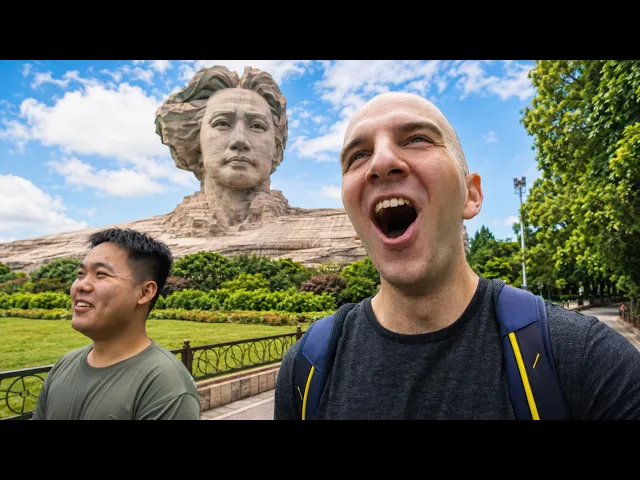
In this video, I explore Changsha (长沙), the capital of Hunan Province, and quickly realise that this might be one of the friendliest cities I have visited in China.<br>I start by heading to Orange Island (橘子洲), one of Changsha’s most famous places, to see the enormous Young Mao Zedong statue. Even before I arrive, a local helps me figure out the metro and basically guides me there without expecting anything in return.<br>Once I reach the statue, the day becomes completely unexpected. Groups of Chinese schoolchildren start coming over to say hello, practise their English, ask me questions, take photos and give me loads of snacks and small gifts. At one point, I have so much food that my bag is basically full.<br>The funniest part is how excited and curious everyone is. Kids start following me around, laughing, shouting and trying to talk to me, while adults also come over and offer me food. It turns into one of the most wholesome interactions I have had anywhere in China.<br>After travelling through cities like Beijing, Shanghai and Shenzhen, Changsha feels completely different. The city is lively and modern, but what really stands out is how open, social and welcoming the people are.<br>This was my first proper day exploring Changsha (长沙), and honestly, the people completely made the experience for me.
Uri Máté explores Changsha, where friendly schoolkids shower him with snacks, locals help for free, and the giant Mao statue makes Orange Island unforgettable.
Travel Guides & Tips in this video
Uri Máté heads to Changsha, Hunan's trendiest capital, and finds a city that lives up to its 'most liveable' reputation. At Orange Island, the giant Young Mao Zedong statue draws massive crowds—especially schoolkids, who swarm him with snacks, gifts, and endless curiosity. Locals guide him through the metro, hand him free souvenirs, and turn his visit into a whirlwind of generosity. From Taiping Street's souvenir bargains to riverside karaoke and dazzling night lights, Changsha proves why it's one of China's friendliest, most unforgettable cities.
Next travel video:
Changsha's Friendliest City: Orange Island, Mao Statue & Sn
In this video, I explore Changsha (长沙), the capital of Hunan Province, and quickly realise that this might be one of the friendliest cities I have visited in China.
I start by heading to Orange Island (橘子洲), one of Changsha’s most famous places, to see the enormous Young Mao Zedong statue. Even...
Changsha, China: Orange Island, Mao Statue & Friendly Locals
Uri Máté discovers that Changsha isn't just another Chinese city—it's a place where strangers become friends. From schoolchildren showering him with snacks to locals guiding him through the metro, every moment is a lesson in warmth. The Young Mao Zedong statue draws him in, but the people keep him there. Forget Beijing and Shanghai; Changsha's hospitality is off the charts. This video captures the pure, unfiltered joy of human connection in China's friendliest city. Watch as a simple day turns into an unforgettable experience.
Attractions in this video: Orange Island, Young Mao Zedong Statue, Taiping Street, Huangxing Road Pedestrian Street
More about the current video:(Published on 2026-08-02)
Uri Máté's latest China adventure lands in Changsha, the capital of Hunan Province and a city that has earned a reputation as one of the country's most liveable. From the moment he steps off the world's fastest train, the atmosphere feels different. The streets buzz with neon, the food smells intense, and the locals seem genuinely eager to welcome him. His first stop is Orange Island, home to the gigantic Young Mao Zedong statue—an iconic sight that even many foreign travelers have never heard of. What starts as a simple sightseeing trip quickly turns into an overwhelming display of Chinese hospitality.
A stranger at the metro helps him buy a ticket and personally guides him to the entrance, then disappears without asking for anything. He barely has time to process the massive sculpture before schoolchildren swarm around him, shouting greetings, practicing their English, and pressing snacks into his hands. The interaction becomes the heart of the video: kids line up for photos, one boy records an entire vlog of him, and others proudly show off their English textbooks. At one point, his bag is completely full of free treats and small gifts. He calls it some of the craziest footage he has ever recorded, and it's easy to see why.
Afterward, he explores Taiping Street, a historic pedestrian area where old architecture mixes with LED skyscrapers. There, he learns a valuable souvenir rule: skip the official stores and buy magnets from grandpas under the bridge, where prices are half of what the big shops charge and free gifts are part of the deal. He continues through Huang Xing Road, where he finds bizarre attractions like a Lego-like skyscraper, golden buildings, and even a Plants vs. Zombies advertisement. But the real charm of Changsha lies in its people. By the river, elderly residents sing karaoke, dance in groups, play instruments in a full band, and ride exercise machines.
Uri reflects that Chinese grandmas and grandpas know how to enjoy life, and the sheer energy of the city keeps surprising him. He also discovers the deeper beauty of temporary things while watching a man paint Chinese poems on the ground with water—an art form meant to evaporate. As night falls, Orange Island transforms again. The skyline erupts with colorful LED animations, constantly shifting like a futuristic video game. He contrasts this bold modernity with Ireland's fear of change, admiring how Chinese cities balance ancient heritage and futuristic design.
After a day packed with snacks, gifts, unexpected celebrity moments, and genuine human connection, he boards the wrong train by accident but still makes it back to Wuhan. It's a fitting end to a day that was never about the sights alone—it was about the countless locals who made Changsha feel like the friendliest city in China.
FAQs (From the traveler's perspective)
Q: How do you get to the Mao Zedong statue on Orange Island?
A: I took the Changsha metro, then bought a ticket for the cute little train that goes to Orange Island. A local guy actually helped me get the ticket and guided me there—without wanting anything in return.
Q: What was it like visiting Orange Island?
A: It was absolutely packed, especially with schoolkids. I barely had a moment alone—kids were running up to me, giving me snacks, asking for photos, and even recording me. I left with my bag full of food.
Q: Is Changsha really as friendly as people say?
A: Yes, it shocked me. Strangers helped me with tickets, kids gave me free food, grandmas and grandpas handed me gifts. I've never experienced hospitality like this anywhere else in China.
Q: Where should I buy souvenirs in Changsha?
A: Avoid the official magnet shops near the monument—they're overpriced. I found much cheaper magnets and pins at Grandpa's stall under the bridge, and he even threw in a free flag.
Q: What is there to do at night in Changsha?
A: The riverside parks are full of grandmas and grandpas singing karaoke, dancing, and playing instruments. Then the whole city lights up with LED skyscrapers—it feels like walking through a futuristic video.