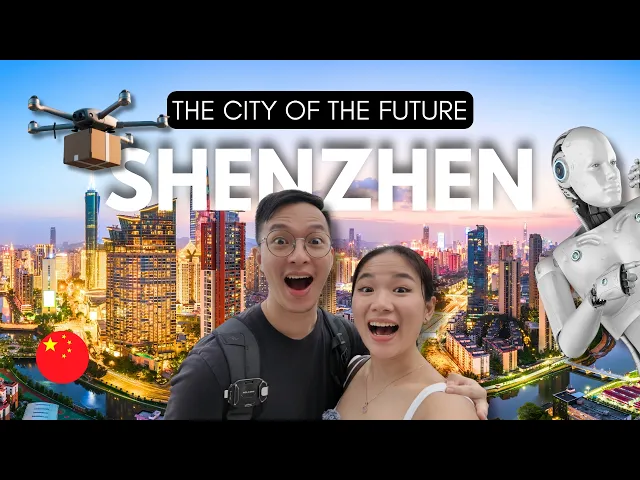
Shenzhen has a reputation for being a city from tomorrow, and in this video Vanessa Huang sets out to prove it. From the opening shot of a building shaped like a giant pair of AirPods to an actual driverless taxi ride, every stop reinforces why this southern Chinese metropolis feels like it has jumped into 2050. The first surprise is Shenzhen Bay Culture Square, a bold new landmark that only opened in November 2025. Vanessa and her companion wander through a tunnel that feels like entering a spaceship, then discover Pink Street hidden inside the building—a curated retail space with a pink McDonald’s, a popular bakery called Anpanman, and a futuristic library with a spiral wooden staircase.
Inside the tech-focused store Eno 100, the future becomes interactive. Vanessa tries an exoskeleton designed to help knees while climbing stairs, plays an automated chessboard until she hilariously loses, and watches a robot make vanilla soft serve. The verdict? The robot is slow, and the ice cream is just okay. A robot pet with a camera nose costs 4,399 yuan, and everything on display is actually purchasable. Next, she explores MixC Shenzhen Bay, where a massive waterfall called The Wave draws crowds, and Bambu Lab shows how 3D printers can create everything from a tiny carrot to an entire city. The affordability of this technology is genuinely surprising, with some printed creations costing only 32 yuan.
One of the most memorable experiences happens at Shenzhen Talent Park. Here, delivery drones are an ordinary part of daily life. Vanessa orders drinks through WeChat, waits about 45 minutes, and collects the package by entering the last four digits of her phone number. The delivery box must be flattened and returned for reuse, and impressively, the price is exactly the same as a regular delivery. A sudden rainstorm sends her running back to the mall, but not before she captures the thrill of seeing drones, coffee-making robots, and a park that feels effortlessly futuristic. The video also includes a full tour of the InterContinental Shenzhen, a city resort with a massive pool, a pirate ship, and amenities that feel far from ordinary.
The second day is dedicated to Gangxia North Station, a five-line interchange with a jaw-dropping ceiling that people stop to photograph, and One Avenue, where the Huawei store feels like a glimpse of tomorrow. Vanessa tries a smartwatch that checks blood pressure, admires a foldable MateBook, and sits inside a Stelato car filled with cameras and screens. Then comes the climax: booking a driverless taxi through an app. A 14-minute ride covering three and a half kilometers costs only 8.5 yuan, about one US dollar. The car drives smoothly, detects everything with sensors, and even offers heated seats. Vanessa Huang leaves convinced that Shenzhen is not just a city with gadgets—it is a place where the future has already become everyday life.
FAQs (From the traveler's perspective)
- Q: What was it like inside the AirPods-shaped building?
- A: It was stunning but a bit confusing. We wandered through a tunnel that felt like entering a spaceship, then found Pink Street downstairs. There was a pink McDonald's, a busy bakery, and even a hidden futuristic library.
- Q: How does drone delivery work at Shenzhen Talent Park?
- A: You order through WeChat, wait around 40 to 45 minutes, then enter the last four digits of your phone number to open the drone's box. After taking your drinks, you flatten the box and put it in a return box so it can be reused.
- Q: Was the robot ice cream any good?
- A: Honestly, it was just normal vanilla soft serve. The robot was slow and placed the ice cream far away instead of handing it to me, so I think a human would do it faster.
- Q: What did you think of the driverless taxi?
- A: It was wild! We paid 8.5 yuan for a 14-minute ride, and the car drove itself smoothly. It detected vehicles with sensors, had heated seats, and even wished me a safe exit when we arrived.
- Q: Is Shenzhen really living in the future?
- A: I think so. Between delivery drones, robot coffee makers, smart glasses, foldable laptops, and driverless taxis, the daily conveniences here feel like science fiction you can actually use.