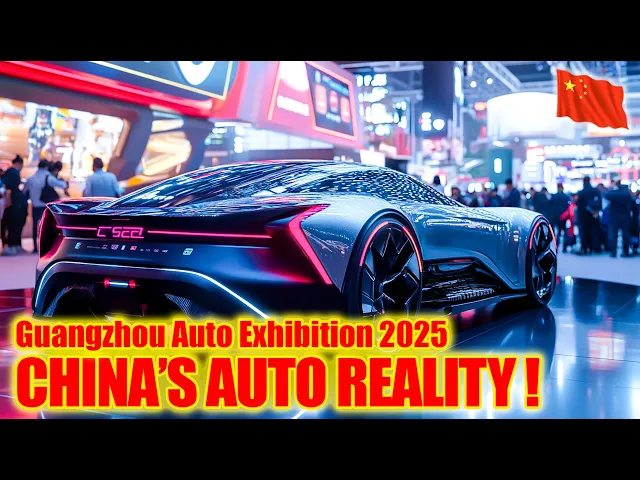
Today I take you inside Guangzhou Auto 2025, one of the most important automotive shows on the planet, where China’s leading car brands are showcasing designs that genuinely redefine what modern vehicles look and feel like. From bold futuristic styling to tech-packed interiors, the pace of innovation here is on a completely different level. But this isn’t just about shiny new cars. I also break down the uncomfortable reality facing legacy Western automakers, whose sales continue to slide in the Chinese market, while Chinese brands surge forward, not only at home but rapidly expanding into global export markets. It matters.
Barrett tours Guangzhou Auto Show 2025 focusing on BYD’s expansive presence and the value proposition of Chinese EVs. He highlights BYD’s three brands under one
Travel Guides & Tips in this video
Barrett takes us through Guangzhou Auto Show 2025, starting inside BYD’s vast hall where the company’s four brands Denza, Fang Ba, BYD, and Yang Wang stretch across the space and showcase a surprisingly diverse lineup. Barrett emphasizes value and rapid product cadence as he highlights budget-friendly options like BYD’s up model, which starts around 74,800 RMB for a 300 kilometer EV, and climbs to 119,800 RMB for the top variant. He notes the brand’s aggressive expansion, exporting to more than 100 countries, and points out BYD’s new flash charging system that can add 400 kilometers in five minutes, a capability he calls “as fast as refueling.” Inside Denza’s N9 he admires the premium touches, the DJI drone pod, and the six-seat configuration, though he jokes about the awkwardness when seats don’t fold as expected. Barrett then surveys BYD’s N8 and N9 interiors, praising seats, tech, fold-flat rear space, and the practical touches like a fridge and facial recognition that personalizes,
Next travel video:
14 min
2025
Guangzhou Auto 2025: China’s EV Innovation and the Global If
Today I take you inside Guangzhou Auto 2025, one of the most important automotive shows on the planet, where China’s leading car brands are showcasing designs that genuinely redefine what modern vehicles look and feel like. From bold futuristic styling to tech-packed interiors, the pace of innovation...
Guangzhou Auto Show 2025 Chinese EVs vs Western Legacy Automakers An 8
The video takes you inside Guangzhou Auto 2025, a pivotal global auto show where China’s top car brands debut designs that redefine modern driving. You’ll see bold, futuristic styling and tech-packed interiors that signal a rapid pace of innovation. The focus isn’t just on new aesthetics; it also lays bare the challenging reality Western automakers face as their sales slip in China while Chinese brands gain momentum at home and are marching into global markets. The message is clear: the center of gravity in the automotive world is shifting toward China, with domestic brands driving the next generation of vehicles and pushing technological and export growth beyond national borders. This alignment of design excellence, advanced tech, and export ambition makes Guangzhou Auto 2025 a barometer for the future of the global EV landscape. The takeaway is not merely about flashy cars, but about a broader power shift in the auto industry and what it means for brands around the world. The video’s
Attractions in this video: Byd Hall, Avatar Pavilion, Tank Trucks, Volvo Stand, Audi Stand
China's INSANE Engineering
Inside XCMG Factory China: Giant Mining Trucks and Mega Mach
More about the current video:(Published on 2025-11-22)
Barrett walks the Guangzhou Auto Show floor, starting at BYD where the hall itself is the showroom. He splits attention across BYD’s four brands and notes the value and breadth of the lineup, especially the low-cost up model and the premium Denza N9. He highlights BYD’s Flash Charging, capable of adding 400 kilometers in five minutes, a dramatic testament to the company’s tech push. Barrett then dives into Denza’s interior and features such as a drone pod and six-seat layout that folds to create bigger cargo space, before moving into the N8 and its hybrid-to-electric transition timeline. He comments on BYD’s Yang Wang U9 and the track-worthy performance on the Nürburgring, weighing practicality versus spectacle. The conversation expands to BYD’s ADAS system Tian Shen, data advantages from millions of kilometers, and the three-tier approach with Denza as the flagship for autonomous driving. Barrett then samples other brands in the hall—Great Wall Motors and its Tank line, Lotus under the Jie Group, and Avatar’s collaboration with Huawei and CL for its advanced tech, including smart mirrors and the large Huawei-influenced dashboard. He reflects on the state of legacy automakers like BMW, Volvo, VW, and Ford in the Chinese market, noting China’s EV dominance and tariff environments shaping a future where Chinese EVs lead exports. Throughout, Barrett peppered the tour with personal notes about his own car shortlist, the struggle for foreign brands to maintain presence, and the broader market consolidation expected as tech standards tighten. Barrett also shares practical travel gear like a PYGtech backpack to move gear between shows. He closes with a snapshot of Neo, their expanding model lineup and battery strategies, and a candid takeaway: Chinese brands are rapidly overshadowing Western brands in technology and value, with Huawei’s ADS and BYD’s data-led improvements driving the shift. Barrett signs off with a teaser about next time and the Guangzhou show’s impact on the global EV market.
FAQs (From the traveler's perspective)
Q: Why are Chinese EVs gaining dominance at Guangzhou Auto Show 2025?
A: Chinese brands like BYD, Avatar, and XiPeng are leveraging aggressive pricing, rapid product cadence, and advanced ADAS data collection to outpace Western legacy automakers.