

Travel Guides & Tips in this video
This 4K travel documentary surveys China’s varied landscapes, geology and landmarks, from Zhangjiajie and Zhangye Danxia to Xinjiang’s Yadan terrain, Tibetan Plateau lakes, gorges, grasslands and coastal wetlands. It also visits caves, temples, ancient towns and modern engineering projects. The original account highlights the age and formation of these places, practical advice for several destinations and the scale of China’s natural and built environments.
Next travel video:

More about the current video:()
Geological landscapes and lakes
The documentary begins at Zhangjiajie National Forest Park in Hunan, where more than 3,000 vertical quartz sandstone pillars rise from the landscape, with some reaching 1,000 feet. The park is a UNESCO World Heritage site. In Gansu, Zhangye Danxia shows layers of red, orange and brown rock colored by iron oxide. Xinjiang’s Yadan landforms have parallel ridges shaped by wind erosion, and the nearby Devil City resembles a deserted stone settlement.
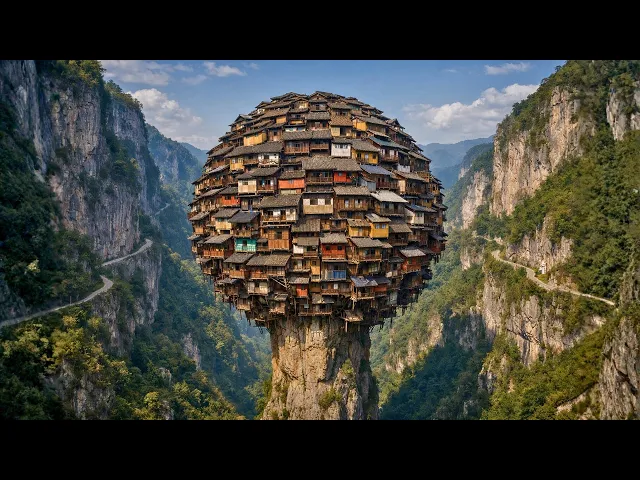
On the Tibetan Plateau, Lake Manasarovar sits at about 15,000 feet and is described as a turquoise spiritual site. Ulan Lake in Inner Mongolia appears deep red because of its salt levels and algae, and its shape looks heart-like in satellite images. The film also features Wuxian Valley, built vertically into its setting, and stone forests formed through chemical erosion of ancient seabeds over tens of millions of years. In Guilin, Reed Flute Cave has more than 70 ancient inscriptions. The route includes Kalajun grassland in Xinjiang, Hulunbuir grassland in Inner Mongolia, the vine-covered Houwu village in Zhejiang, Ginkgo Village in Yunnan and an apricot blossom valley.
Mountains, heritage and engineering
Other landscapes include Tianmen Mountain in Hunan, with a large natural arch once flown through by a small aircraft, and the snow mountains, glacial lakes and meadows of Daocheng Yading in Sichuan. Jiuzhaigou’s travertine pools, Fanjing Mountain’s ancient metamorphic rock and the red sandstone of Danxia Mountain in Guangdong add further geological variety. The documentary also shows Yunnan’s red land, Liaoning’s Red Beach, Blue Moon Valley, the high-altitude lakes Yamdrok, Namtso and Qinghai, Crescent Spring beside Mingsha Mountain, Tiger Leaping Gorge and Taihang Grand Canyon.
Human landmarks include the Mogao Grottoes’ murals, the Longmen Grottoes’ Buddhist statues, the Leshan Giant Buddha and the Three Gorges Dam. It also visits Huashan, Yandang Mountain, Changbai Mountain’s crater lake, Hailongtun, Nanxun Ancient Town, Fenghuang Ancient Town, the Bailong Elevator and the Beipanjiang Bridge. The documentary presents these sites through a geological and travel perspective, showing natural formations alongside historic places and modern infrastructure.
FAQs (From the traveler's perspective)
- Q: What was the most surreal place you visited in China?
- A: Each place had its own unique sense of surreality, but the Zhangjiajie National Forest Park, with its thousands of vertical sandstone pillars rising through the clouds, felt like stepping onto another planet. The sheer density and height of the columns, some over 1000 feet tall, created a landscape that defied logic.
- Q: How did you find these hidden places?
- A: The journey was based on extensive research into China's most extraordinary geological wonders. We focused on places that have been shaped by millions of years of tectonic activity and erosion, many of which are off the typical tourist trail. The goal was to find landscapes that are so strange and beautiful they seem almost impossible.
- Q: Was it difficult to access these remote locations?
- A: Some places, like the high-altitude lakes on the Tibetan Plateau, required significant travel and adaptation to the altitude. Others, like the Bailong Elevator and Duge Bridge, are more accessible but still offer a profound sense of scale and engineering wonder. The Guoliang Tunnel, carved by hand through a cliff, was a humbling reminder of human determination against extreme terrain.
- Q: What was the most surprising natural phenomenon you witnessed?
- A: The red lake in Inner Mongolia, Oolen Lake, was incredibly surprising. Seeing a massive, heart-shaped body of water that is a deep, almost unnatural red in the middle of a dry desert was shocking. It's caused by salt-tolerant algae and minerals, but it looks like something from a science fiction film.
- Q: How did the video capture the surreal feeling of these places?
- A: The 4K cinematic footage was crucial. We used slow, sweeping shots to emphasize the massive scale and otherworldly textures of the landscapes. The layering of mist, light, and dramatic terrain helps to build that sense of entering a dream or a digitally created world, even though everything is 100% real.
