
Travel Guides & Tips in this video
A Shenzhen resident of about 10 years explains how the city grew in roughly 40 years. He covers its 1980 start as a special economic zone, the comparison with Silicon Valley, Hong Kong's role, and companies such as Huawei, Tencent and DJI. He cites a population of around 18 million, skyscrapers, the metro, electric buses and taxis, parks, a busy container port and early-2025 helicopter rides. Local residents also describe why they like living there. Figures are the narrator's own claims, so treat them as his view of the city.
Next travel video:

More about the current video:()

Shenzhen's rise over 40 years
The narrator, a creator who has lived in Shenzhen for about 10 years, says the city is less well known than Beijing or Shanghai but is a powerhouse of urban development and innovation. He sets out to explain how it grew in 40 years. He says that after China began opening its economy in 1978 under Deng Xiaoping, Shenzhen was chosen in 1980 as one of the first special economic zones, a testing area for reforms with incentives such as tax breaks and fewer regulations.
He compares the Shenzhen tech city with San Francisco and calls it the Silicon Valley of China, but says it is also a major manufacturing center, claiming that about 80% of electronics are made in Shenzhen or nearby Greater Bay Area cities. He says Hong Kong capital helped the city in the 1980s and 1990s, and that Shenzhen overtook Hong Kong in GDP in 2018. By 2024 he puts it at about 510 billion US dollars, third among Chinese cities behind Shanghai and Beijing. He names Huawei, Tencent, DJI and BYD as companies linked to the city, and says the government also built universities and research centers.
Innovation and urban development
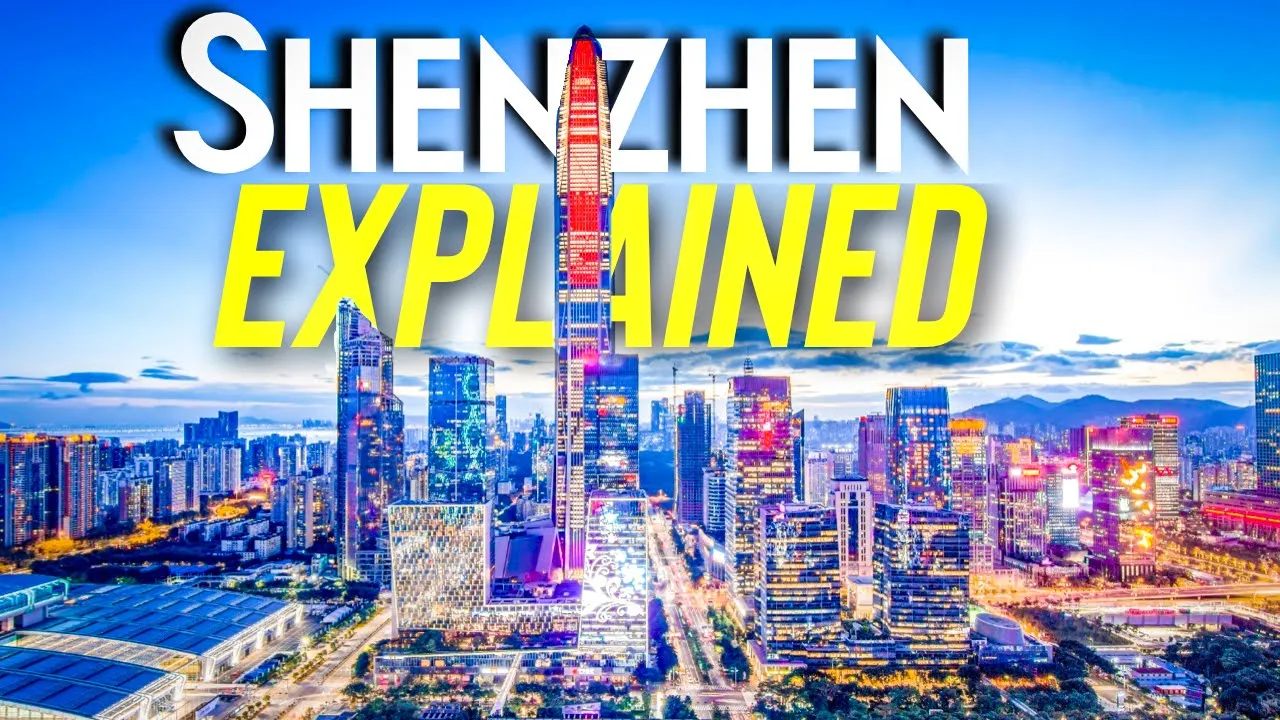
The narrator says the permanent population reached about 18 million at the end of 2024, up from about 30,000 in 1980. He describes the skyline, saying Shenzhen is third in the world for buildings over 150 meters and that its tallest building is the second tallest in China. He adds that the Shenzhen Stock Exchange was established on December 1, 1990, that the port handled about 29.88 million containers in 2023, and that the city has about 70 billionaires and over 1,200 parks. He also calls it safer than the US.
On getting around, he says Shenzhen's bus fleet of over 16,000 vehicles became fully electric in 2017 and its more than 22,000 taxis in 2018, and that new vehicle registrations have been limited by quota since 2014. The metro, which began in 2004, now has over 560 km of line, more than 300 stations and 16 lines, with over 6 million daily riders in 2023. He mentions projects such as indoor skiing and, in early 2025, 15-minute helicopter rides as part of a low-altitude economy.
Residents interviewed in the video describe liking the parks and the seaside. The narrator also shows new areas near a new ferry port and a K11 that was about to open. All figures and opinions are the narrator's and his guests' own claims.
Shenzhen tech city today
He ends by calling Shenzhen one of the most futuristic cities in the world.
FAQs (From the traveler's perspective)
- Q: When did Shenzhen become a special economic zone?
- A: The narrator says Shenzhen was chosen in 1980 as one of the first special economic zones, after China began opening its economy in 1978 under Deng Xiaoping.
- Q: How many people live in Shenzhen?
- A: The narrator says the permanent resident population reached around 18 million by the end of 2024, compared with about 30,000 in 1980.
- Q: How big is the Shenzhen Metro?
- A: The narrator says it began operating in 2004 and now spans over 560 km with more than 300 stations on 16 lines, with over 6 million daily passengers in 2023.
- Q: Are Shenzhen's buses and taxis electric?
- A: The narrator says the bus fleet of over 16,000 vehicles became fully electric in 2017 and that over 22,000 taxis were converted to electric in 2018.
- Q: How is Shenzhen different from Silicon Valley?
- A: The narrator compares Shenzhen with San Francisco and calls it the Silicon Valley of China, but says it is also a major manufacturing center, claiming about 80% of electronics are made there or in nearby Greater Bay Area cities.
- Q: When did Shenzhen's GDP overtake Hong Kong's?
- A: The narrator says Shenzhen overtook Hong Kong in GDP for the first time in 2018 and reached about 510 billion US dollars by 2024.
- Q: Does Shenzhen limit new cars?
- A: The narrator says that since 2014 the city has limited new vehicle registrations through a quota system, with a fixed number of new license plates handed out by lottery and auction each year.
- Q: What are the helicopter rides in Shenzhen?
- A: The narrator says Shenzhen introduced 15-minute helicopter rides in early 2025 for residents and tourists, as part of China's push into the low-altitude economy.
