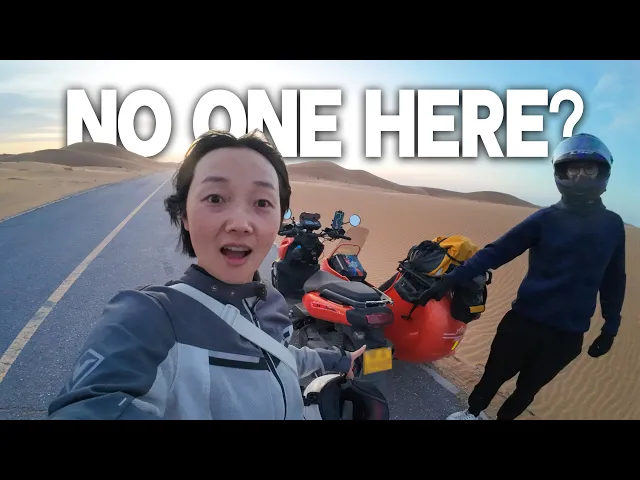
Join us as we cross the Gobi Desert from Alxa Left Banner to Alxa Right Banner, passing through the Tengger Desert — one of the most remote regions in Inner Mongolia, China. Along the way, we meet Bactrian camels, connect with local residents living in isolated desert villages, and experience life on the edge of civilization.</p><p>Our adventure leads us to the Badain Jaran Desert, home to the tallest sand dunes in the world and over 100 permanent freshwater lakes hidden between them — a natural wonder unlike anywhere else on Earth. We rent a 4x4 pickup truck and drive across the shifting dunes to visit the people who live in this surreal landscape.</p><p>Deep in the desert, we discover the Badain Jaran Temple, a remote Tibetan Buddhist temple believed to have been built in the 18th century during the Qing Dynasty. Its presence reveals the deep roots of Buddhism in Inner Mongolia, even in one of the harshest environments on the planet.</p><p>Join us on a journey to one of China's most mysterious places 🎬</p><p>Do you want to see more of my adventures? 🎬</p>
Little Chinese Everywhere explores the Badain Jaran Desert, discovering hidden lakes, the world's highest sand dune and a 300-year-old temple in a stunning, off
Travel Guides & Tips in this video
In this episode of *China's Sahara That's Full Of Lakes?*, traveler Little Chinese Everywhere ventures into the stunning Badain Jaran Desert. Far from a barren wasteland, this desert hides shimmering lakes, the world's highest sand dune, and a 300-year-old Tibetan Buddhist temple. The journey is a wild ride—literally—as our host and her partner surf over 60-degree sand dunes in a pickup truck, discovering how herders live with Wi-Fi, solar panels, and a surprising oasis-like serenity. Watch as they climb Bilutu Peak, taste a local lamb delicacy, and explore a desert that defies all expectations.
Next travel video:
23 min
2025
Crossing China's Gobi Desert to Badain Jaran's Hidden Lakes
Join us as we cross the Gobi Desert from Alxa Left Banner to Alxa Right Banner, passing through the Tengger Desert — one of the most remote regions in Inner Mongolia, China. Along the way, we meet Bactrian camels, connect with local residents living in isolated desert villages, and experience life on...
This episode takes viewers deep into the heart of China's most surreal landscapes, where the Gobi and Badain Jaran Deserts meet. The traveler crosses from Alxa Left Banner to Alxa Right Banner, passing through the Tengger Desert, one of Inner Mongolia's most remote regions. Along the way, Bactrian camels appear, and local residents in isolated desert villages share their extraordinary lives. The real magic begins at the Badain Jaran Desert, home to the world's tallest sand dunes and over 100 permanent freshwater lakes hidden between them—a natural wonder unlike anywhere on Earth. Renting a 4x4 pickup truck, the adventurer drives across shifting dunes to visit people living in this surreal landscape. Deep in the desert, a remote Tibetan Buddhist temple emerges: the Badain Jaran Temple, believed built in the 18th century during the Qing Dynasty. Its presence reveals the deep roots of Buddhism in Inner Mongolia, even in one of the harshest environments on the planet. This is a journey to,
Attractions in this video: Badain Jaran Desert, Bilutu Peak, Tengger Desert, Tibetan Buddhist Temple, Gobi Desert
More about the current video:(Published on 2025-08-02)
In this episode, traveler Little Chinese Everywhere explores the Badain Jaran Desert, a place that defies the typical image of a barren wasteland.
The journey begins after a motorbike breakdown, forcing a detour for repairs. The next three days are an extreme desert ride: crossing the Tengger Desert, then heading south to Alxa Right Banner, and finally visiting Badain Jaran—home to the world's highest sand dunes and mysterious permanent lakes.
Along the way, the desert surprises with its greenery, thanks to sand control projects and underground springs. In a small town, Little Chinese Everywhere enjoys a local meal of yogurt noodles (suanjiumian) and learns from a Mongolian shop owner how desert communities rely on underground water and rainfall.
To enter the dunes, they switch from motorbike to a pickup truck with a local driver, Master Wang. He shares how his family was the first to drive into the desert in 2000; before that, herders traveled by camel over half a month. The ride itself is a roller coaster, with 60-degree slopes and towering dunes. A highlight is Bilutu Peak, the world's highest stationary sand dune at over 500 meters high. Little Chinese Everywhere notes that these massive dunes are stationary because the sand compresses into sandstone over thousands of years.
The desert also hides a 300-year-old Tibetan Buddhist temple, which sparks a reflection on Marco Polo and Kublai Khan's religious tolerance. The only monk who lived there has since married a herder and moved away. Despite being remote, the oasis houses have solar panels, Wi-Fi, and air conditioning. One elderly woman has lived alone with her sheep for her entire life, content in solitude.
The episode ends with a simple but luxury meal of pepper and pork, plus a taste of lamb trotters—a local delicacy offered by fellow drivers. The desert, with its lakes, sand dunes, and resilient communities, proves to be far more vibrant and livable than imagined.
FAQs (From the traveler's perspective)
Q: What were the yogurt noodles like?
A: It was noodles cooked with dried lamb and yoghurt—simple, traditional, and no additives.
Q: Why are there so many lakes in this desert?
A: The underground water feeds all the lakes; they stay almost all year round, even in winter.
Q: How high is the world's highest sand dune?
A: Bilutu Peak is over 500 meters high, and because the sand is so compressed, it's stationary.
Q: Do people actually live in the desert?
A: Yes, herders have lived here for generations; now they have solar panels, aircon, and Wi-Fi.
Q: What did the monk in the temple do?
A: He found a wife who is a herder in the left banner, so he left the temple to go herding with her.