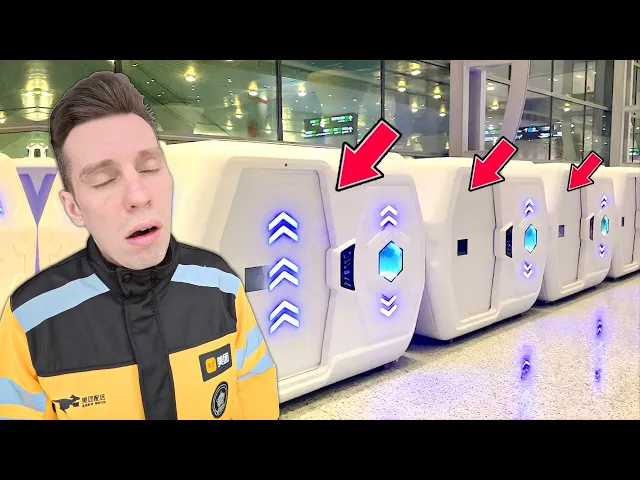
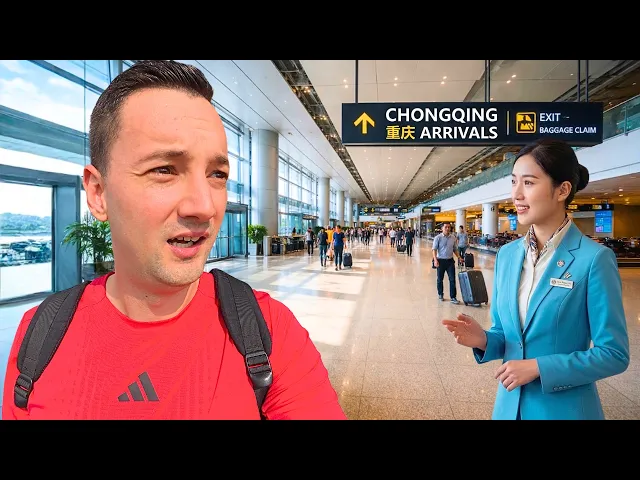
I spent 48 Hours in Sleep Pods at an Airport in China 🇨🇳 and what I discovered completely shocked me! In this video I tried airport sleep pods, experienced 48 hours living in capsule-style airport hotels, and spent an overnight in a Chinese airport sleep pod inside some of the most futuristic airports in the world! I visited Beijing Daxing International Airport and Chongqing Jiangbei International Airport, where airports feel mores like high-tech cities than transit hubs. Inside you’ll find public sleep pods, humanoid robots, smart technology, restaurants, hotels, massage zones, and even places to relax or explore during long layovers. I also took a flight on a Chinese airline to experience what flying in China is really like. This is more than just an overnight in sleep pods at an airport in China — it’s a real look at the future of travel. If you’ve ever wondered what it’s like to try public sleep pods or spend 48 hours in capsule hotels inside airports, this video shows it all. Join me and see how China’s $17 billion mega airports are changing travel forever.
Homeless Pelican spends 48 hours living in sleep pods and exploring the futuristic mega airports of Chongqing and Beijing, discovering robots, gardens, free luxuries, and a whole new level of travel.
Travel Guides & Tips in this video
Ever wondered if you could survive—and actually enjoy—48 hours inside an airport? Homeless Pelican proves it's not just possible, it's a futuristic vacation. From cozy sleep pods in Chongqing to the mind-blowing, starfish-shaped Daxing Airport, this adventure turns transit into a destination. Think humanoid robots, free libraries, massage chairs, and even a spa. It's like living in a sci-fi movie, but with better noodles.
48 Hours in Airport Sleep Pods at China's Mega Airports
I spent 48 Hours in Sleep Pods at an Airport in China 🇨🇳 and what I discovered completely shocked me!
In this video I tried airport sleep pods, experienced 48 hours living in capsule-style airport hotels, and spent an overnight in a Chinese airport sleep pod inside some of the most futuristic...
48 Hours Living in Sleep Pods at China's Futuristic Mega Airports
In this video, our traveler spends 48 hours inside futuristic Chinese airports, sleeping in public sleep pods and exploring high-tech amenities. From Beijing Daxing to Chongqing Jiangbei, these mega airports feel like smart cities. With humanoid robots, massage zones, and capsule hotels, it's a glimpse into the future of travel. But are the sleep pods comfortable? Watch to find out!
Attractions in this video: Beijing Daxing International Airport, Chongqing Jiangbei International Airport, Sleep Pods, Humanoid Robot Store
More about the current video:(Published on 2026-05-10)
<p>Homeless Pelican challenges himself to spend 48 hours living inside two of China's most futuristic airports, and the experience completely reshapes his idea of travel. He starts his journey at Chongqing Jiangbei International Airport, checking into a compact sleep pod that rents for as little as 50 yuan for five hours. The capsule is small but meticulously clean, equipped with a fan, an SOS button, a fire extinguisher, and mood lighting that shifts through a galaxy of colors. There is no shower inside the pod, so he relies on public airport bathrooms, which are spotless and stocked with quality single-use towels. He notices the airport is buzzing at 2 a.m., with crowds queuing for noodles and people napping on benches or massage chairs. It is a lively, safe, and surprisingly comfortable environment.</p><p>The next day, he flies to Beijing Daxing International Airport, the most expensive airport ever built, costing $25 billion. The sheer scale is overwhelming. The airport is shaped like a starfish with five legs, designed by the late architect Zaha Hadid. It was constructed in just five years with 40,000 workers on site 24/7. Inside, it feels more like a high-tech city than a transit hub. He checks into a second sleep pod hotel near the gates, which costs only 238 yuan when booked online and includes a shared shower area with excellent water pressure. The hotel is quiet, private, and feels like a small cabin on a ferry.</p><p>Exploring the airport, he is stunned by the amenities. There is a humanoid robot store where the robots greet him, shake hands, and even bow. He finds public gardens with real plants, a bamboo garden with animated walls, a reading pavilion with private soundproof booths, free computer stations, a cloud audio library, and even a hairdresser. The airport has multiple playgrounds, baby care stations with fridges for milk, and nursery rooms. He spots massage chairs everywhere, free charging stations with both Type-C and USB ports, and wristbands for passengers needing assistance. The food is affordable and delicious; he enjoys a steamed dumpling set with orange juice for 42 yuan, following the golden rule that if lots of locals are eating there, it is worth trying.</p><p>He also discovers that the airport has its own museum-like exhibition about its construction, complete with a model, awards, and a digital floor screen. There is a free public phone for three-minute calls, vending machines selling airport-shaped ice cream, and even a Disney store. The cleanliness is obsessive; workers constantly clean the floors on vehicles. He feels completely safe leaving his luggage with airport staff for up to seven days free of charge, a service he trusts far more than in Europe. His drone is confiscated at security because drones are not allowed in Beijing, but the process is handled smoothly, with staff promising to ship it to his home address.</p><p>By the end of his 48-hour experiment, Pelican is genuinely impressed. Both pod hotels were affordable, though three times more expensive than his usual mainland China stays. Daxing Airport, in particular, blew his mind with its endless amenities, futuristic design, and overall vibe of calm efficiency. He concludes that spending two days in a Chinese mega airport is not just survivable, but a unique and highly recommended experience. He leaves ready to explore Beijing city, with a sense of wonder at how China has turned transit into a destination.</p>
FAQs (From the traveler's perspective)
Q: What were the sleep pods like?
A: They were small but very clean, with a single bed, pillow, blanket, fan, mood lighting, and an SOS button. No shower though.
Q: Was it expensive to stay in the airport pods?
A: It was affordable. 50 yuan for 5 hours or 180 for a night, but still about three times more expensive than regular hostels in China.
Q: What was the most surprising thing you found at the airport?
A: Probably the humanoid robot store and the fact that the airport has a library, a spa, a hairdresser, and even a garden with a piano.
Q: Could you sleep comfortably in the pods?
A: Yes, especially in Beijing Daxing. It was super quiet, dark, and the bed sheets smelled fresh. I didn't even need my earplugs.
Q: What happened to your drone?
A: Security took it because drones are not allowed in Beijing. They took my address and promised to ship it to me, which I trusted completely.